Smart CEOs automate.
They automate finance.
They automate reporting.
They automate onboarding.
And yes, they should automate training.
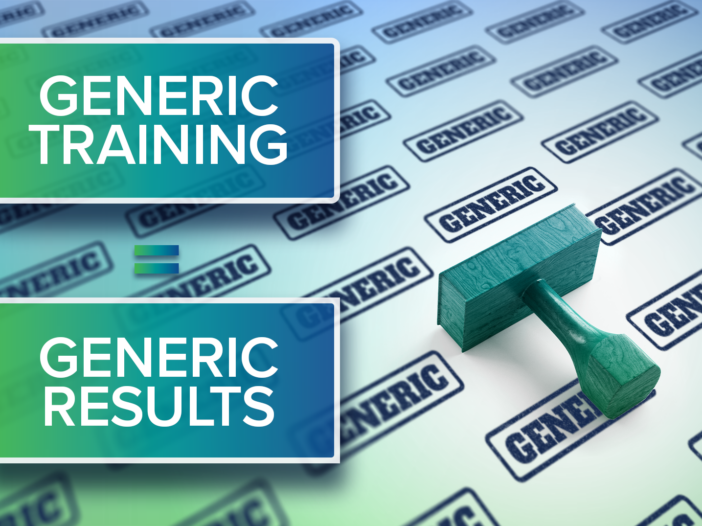
Automation is not a mistake. The mistake is automating something generic and expecting it to produce something exceptional. That is like making a copy of a blurry image and hoping it becomes sharper. It does not.
Why Leaders Turn to Off-the-Shelf Training
When business owners buy off-the-shelf LMS libraries, they’re usually trying to do the right thing. Their goals are practical and reasonable and they want:
- Consistency
- Speed
- Less dependence on leaders
- A way to scale without explaining the same things repeatedly
For safety protocols, compliance requirements, and certifications, generic training is often appropriate. But those elements are not what make customers choose your company.
What Generic Training Can’t Teach
Generic training teaches industry standards, but your customers are not buying an industry standard, they are buying your standard.
They buy:
- Your judgment calls
- Your nuance
- Your expectations
- Your culture
- Your way of doing the work
When you automate generic leadership or operational training, you’re not removing effort, you’re replicating misalignment at scale.
Employees complete the modules. Certificates are checked off. And leaders are left thinking, “They are trained, just not trained the way we do things.”
When Automation Amplifies the Wrong Signal
This is where the problem becomes subtle and dangerous.
When training does not reflect how a company actually operates, people notice. Senior employees begin to say things like:
- “Just get it done to make the boss happy.”
- “That’s not really how we do it here.”
- “You’ll learn the real way on the job.”
Training becomes a formality instead of a foundation. Culture rarely collapses overnight; it drifts, and automation accelerates whatever you feed into it. If the input is generic, the output will be generic.
Why Leaders Lose Trust in Training
Over time, another issue emerges: leaders stop believing in training. Not because training does not work, but because it was never truly theirs. It did not reflect their thinking, their standards, or their expectations. As a result, they step back in to correct, redo, and ultimately become the bottleneck again. This does not happen because their people cannot learn, but because the system was never designed to teach their way of thinking.
The Right Way to Automate Training
Automation is not the problem; it is a multiplier. The real question is “what you are multiplying?
When you automate custom training, something powerful happens. Your voice gets preserved
- Your standards get reinforced
- Your culture stays intact
- Your people learn faster
- Your leaders regain time
Yes, it takes more effort upfront, but in return, you gain clarity, consistency, and confidence at scale.
Why Custom Training Changes Results
Custom training does not replace generic content; it builds on top of it. Compliance training keeps you safe, but custom training makes you distinct. At Elevated Systems, we help companies turn that distinction into a structured, scalable advantage.
At Elevated Systems, we help companies:
- Extract their real operating system
- Design training with professional educators
- Automate learning that reflects how they actually work
- And ensure absorption across roles and generations
Because training shouldn’t just transfer information.
Training should not simply transfer information; it should transfer judgment, standards, and identity.
The Question That Matters
If someone joined your company tomorrow…
Would off-the-shelf LMS training teach them how to do the job— or how to do the job your way?
Because automation is smart.
But automating a generic LMS library will always produce generic results.