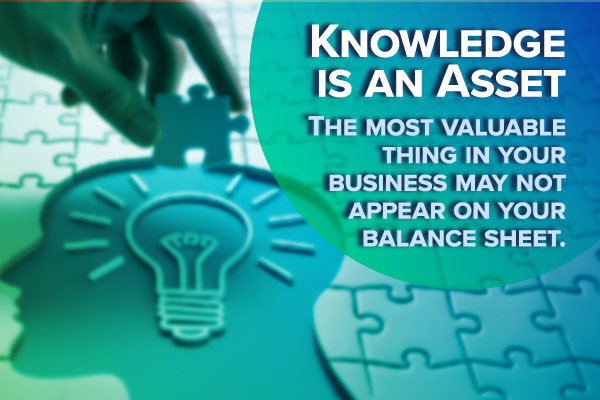
The most valuable thing in your business may not appear on your balance sheet.
It is the knowledge behind the way your company works: how your best people solve a difficult client problem, how your team recognizes risk before it becomes expensive, how you maintain quality under pressure, and how you deliver an experience customers come back for.
That organizational knowledge is a real business asset. But there is an important catch: knowledge creates lasting value only when it can move beyond the person who currently holds it.
If the owner must approve every judgment call, if one senior employee is the only person who knows how a critical process really works, or if new hires learn mainly by asking whoever happens to be available, the company has knowledge – but it does not fully own that knowledge yet.
It is renting it from a few people.
Your business already has a knowledge portfolio
Professional service companies often think of their assets as their people, client relationships, software, brand, and cash flow. All of those matter. But underneath them sits a less visible portfolio of know-how.
- The steps your team follows to produce a reliable result
- The judgment experienced employees use when the standard process does not quite fit
- The language that builds trust with a particular kind of client
- The quality checks that prevent rework
- The lessons learned from projects that went well – and projects that did not
- The small decisions that protect margin, safety, compliance, and customer satisfaction
This is more than a collection of instructions. It is the accumulated intelligence of the organization. The international knowledge-management standard ISO 30401 describes knowledge management as a way for organizations to enable value creation through knowledge. In plain English: what your company knows should help the company perform, improve, and grow – not simply live in someone’s memory.
For a young company, informal knowledge sharing can work surprisingly well. The founder sits near everyone. Questions are answered in real time. New employees absorb the culture by watching. But as the company adds people, locations, service lines, or management layers, that informal model begins to strain.
The knowledge did not become less valuable. It became harder to reach.
When valuable knowledge remains trapped in people
You can usually spot trapped knowledge by the behaviors it creates.
A project pauses until a particular manager responds. Two employees complete the same task in completely different ways. A new hire hears, “That document is technically correct, but it is not how we really do it.” A top performer becomes the unofficial help desk for the entire company. The owner takes a vacation but never truly leaves.
These are not isolated communication problems. They are signs that the organization has not yet converted individual expertise into shared capability.
This kind of unwritten, experience-based know-how is often called tribal knowledge. Tribal knowledge is not inherently bad. In fact, it often contains the nuance that makes a company exceptional. The risk comes from allowing it to remain inaccessible, inconsistent, or dependent on a single person.
That creates several business problems at once:
- Key-person risk. A resignation, retirement, illness, or promotion can remove critical knowledge from daily operations.
- Founder dependency. Growth is constrained by how many questions and decisions one person can handle.
- Inconsistent delivery. Employees fill gaps with their own interpretations, so customers receive different experiences.
- Slow onboarding. New hires spend too much time hunting for answers or waiting for someone to teach them.
- Leadership drag. Your most experienced people repeat explanations instead of improving the business.
- Weak transferability. A company that depends on specific individuals is harder to hand to a management team, successor, investor, or buyer.
As we explored in Every Service Business Is a Training Business – Part 1, service companies do not scale on talent alone. They scale on how quickly and consistently people become effective. That requires a deliberate way to transfer what the organization knows.
Documentation is necessary – but it is not the finish line
The natural response is to document everything. That is a good instinct, but a folder full of documents is not the same as a usable knowledge system.
An SOP can tell someone what steps to follow. A policy can define a rule. A checklist can prevent a missed task. Those tools are essential, but employees still need to understand when the process applies, why each step matters, what good performance looks like, and how to respond when reality presents an exception.
That is the difference between storing information and building capability.
Think about a recipe. A written recipe can list ingredients and steps, but it does not automatically teach a new cook how to recognize the right texture, adjust for an unfamiliar oven, or recover when something begins to go wrong. Those are teachable judgments – but only if someone makes them visible.
The same is true in a business. If your knowledge capture stops at a PDF, you may have preserved words without transferring competence.
The four stages of turning knowledge into an asset
A practical knowledge system moves through four stages: capture, structure, teach, and maintain.
1. Capture what matters most
Do not begin by attempting to record every fact in the company. Start with knowledge that is valuable, vulnerable, and frequently used.
Ask: What do customers count on us to do exceptionally well? Where do errors create the greatest cost? Which questions repeatedly reach the owner or senior team? What would be hardest to replace if a key employee left next month? Which process most affects a new employee’s first 90 days?
Interview the people doing the work, observe the process, and look for the decision points hidden between the official steps. The goal is not merely to write down what happens. It is to uncover why capable people make the choices they make.
2. Structure the knowledge
Raw expertise is rarely organized for someone else to learn. It may arrive as stories, screenshots, old documents, voice notes, demonstrations, and exceptions remembered halfway through an interview.
Structure turns that material into a clear learning path. Related ideas are grouped. Prerequisites come first. Complex processes are broken into manageable pieces. Roles and responsibilities become explicit. Examples show the difference between acceptable and excellent work.
This is where educational expertise matters. Subject-matter experts know the work; educators know how to make that expertise understandable and retainable.
3. Teach for application – not exposure
Employees do not learn simply because information was sent to them. Effective training gives them a reason to pay attention, explains concepts in context, lets them make choices, and checks whether they can apply what they learned.
That may include scenarios, demonstrations, short knowledge checks, branching decisions, guided practice, or role-specific examples. The format should match the work. The objective is not to make the training flashy. It is to help the employee perform correctly when the manager is not standing beside them.
This is also why generic libraries cannot carry the full weight of company-specific training. They can cover universal topics, but they cannot teach the particular methods, standards, language, and judgment that differentiate your business. Our article Generic Training = Generic Results explains that distinction in more detail.
4. Maintain it as the business changes
A knowledge asset is not a one-time documentation project. Processes evolve. Software changes. Customers raise the standard. The team learns a better way.
Assign an owner to each critical learning module or process. Establish a review rhythm. Give employees a simple way to flag outdated material. When an important lesson is learned, decide whether it belongs in the shared system instead of allowing it to remain with the person who discovered it.
ISO’s knowledge-management guidance treats the system as something an organization establishes, maintains, reviews, and improves. That continuous mindset is exactly right: useful knowledge should mature with the business.
What changes when the company owns its knowledge?
The first benefit is usually relief. The same questions stop reaching the same people. New hires have a clearer path. Managers can coach against a shared standard instead of relying on personal preference.
Then the strategic benefits begin to compound.
- Onboarding becomes faster and more consistent because every employee receives the same foundation.
- Quality becomes easier to reproduce across teams, managers, and locations.
- Delegation becomes safer because expectations and decision boundaries are visible.
- Leadership time shifts from repeated explanation to coaching, improvement, and growth.
- The company becomes more resilient when an experienced employee leaves.
- The business becomes more transferable because its way of operating can survive a change in leadership or ownership.
This does not make people less important. It makes their expertise more influential. Instead of using the best employees as permanent bottlenecks, the company gives their knowledge reach. Their experience can improve the performance of every person who follows them.
It also creates room for better judgment. Clear training does not eliminate human thinking; it protects employees from wasting that thinking on avoidable confusion. When routine knowledge is accessible, people can focus their attention on the exceptions, relationships, and innovations that genuinely need it.
A simple test: does your company know what your best people know?
Consider one process that matters deeply to your customers. Then ask yourself:
- Could a capable new employee find the current process without asking around?
- Would the process explain the reasoning behind critical decisions?
- Could the employee see or practice what good performance looks like?
- Would two managers teach it substantially the same way?
- Is there a clear owner responsible for keeping it current?
- Could the process continue if its most experienced practitioner were unavailable for 30 days?
If several answers are no, that does not mean your business lacks knowledge. It means you have an opportunity to convert existing knowledge into a stronger asset.
Start with one high-impact area. Capture the expertise. Organize it. Turn it into training people can absorb and apply. Measure where learners struggle. Refine it. Then move to the next process.
Over time, you are not simply building a library of courses. You are building organizational memory – and making the business less dependent on who happens to be in the room.
Your expertise should outlive the explanation
ElevatED Systems was built around a simple observation: smart leaders were burning out from explaining the same things over and over, while strong businesses stalled because their knowledge lived only in people’s heads. The full Elevated Systems origin story is rooted in that problem.
Your company’s knowledge is already creating value every day. The question is whether that value is portable, teachable, and durable – or whether it disappears whenever the right person is unavailable.
When you capture what makes the business successful and turn it into structured, interactive training, knowledge stops being a private advantage held by a few people. It becomes an organizational asset the entire team can use.
And that is when the company becomes easier to run, easier to grow, and more capable of succeeding beyond any one person.
Ready to see where your organization’s knowledge is most vulnerable?
Take the ElevatED Systems Training Readiness Self-Assessment to identify the processes and knowledge gaps that should be addressed first. Take the Self-Assessment →
Sources and editorial notes
ISO 30401:2018 – Knowledge management systems – Requirements (external reference supporting the knowledge-management framework).